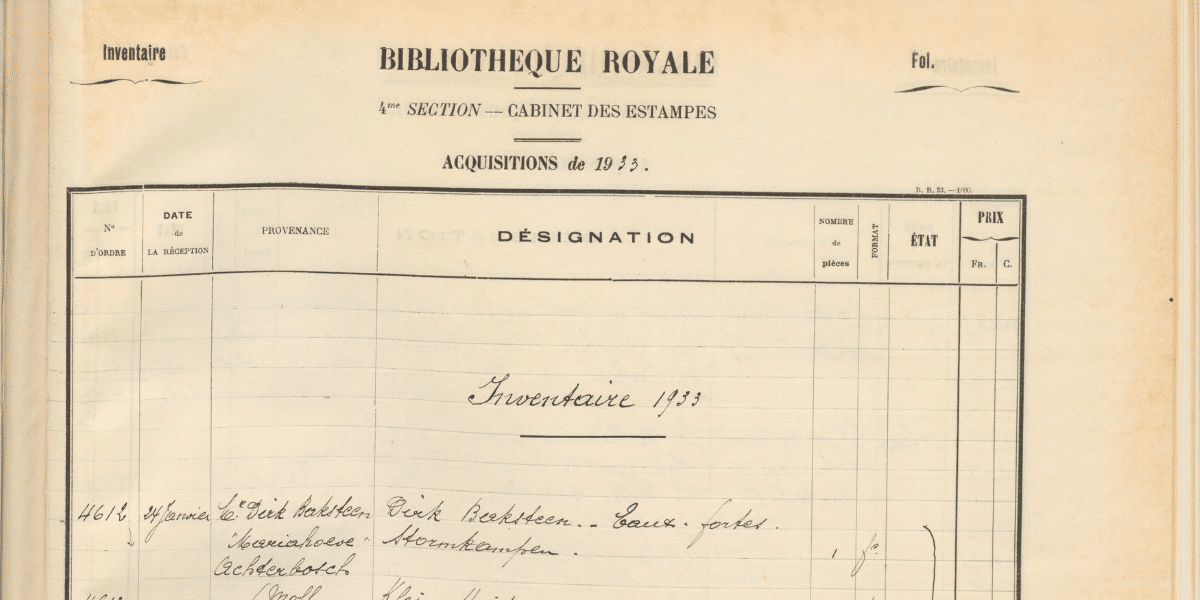
The handwritten registers provide an overview of all works on paper acquired by KBR during this period, offering better insight into the provenance of the collection: where the works came from, when they were added to the collection, and through which channels (such as purchase or donation) they were acquired. In this way, the diverse origins of the collection become more traceable.
Why this step?
The digitisation of the acquisition registers is part of KBR’s broader strategy to make its collections more accessible and transparent. Until now, these registers could only be consulted physically or internally, limiting access to those who could visit in person or submit specific research requests.
Opening up these registers is not only a step forward in research accessibility, but also aligns with the growing attention to provenance history. In particular, for the period during and after the Second World War, acquisition registers can contain important information about potentially problematic provenance, such as looted art, forced sales, or other forms of involuntary transfer of cultural heritage.
By making this data digitally accessible, it becomes easier to conduct provenance research and to identify possible gaps or questions regarding the provenance of collection items within KBR.
A broader effort
The acquisition registers of the Print Room after 1966 are not freely accessible online for privacy reasons, but can be consulted on site in digital or paper form. The registers for the period prior to 1933, up to and including the establishment of the Print Room in 1850, will be made available online later this year. Priority was given to the period 1933–1966, which coincides with the rise of Nazi Germany, the Second World War, and the immediate post-war years.
This digital publication is part of a wider effort within KBR to make its provenance data more transparent and searchable. The registers of other heritage collections will also be digitised in the near future.
What can you find in the acquisition registers?
The registers contain information on all types of acquisitions: purchases, donations, bequests, and exchanges. Individual entries are dated and include the name and address of the third party, as well as a brief description of the transferred item. The information is limited to the moment of acquisition; previous owners of the prints or drawings are generally not mentioned. For that, provenance research through other sources is necessary.
Quick guide
The registers can be consulted online via opac.kbr.be, KBR’s general catalogue.
The inventory numbers of individual collection items indicate in which corresponding register to search. These numbers consist of series numbers and sequence numbers.
For example, the drawing Minerva and Telemachus by Mattheus Ignatius van Bree bears the inventory number S.IV 94515. This number refers to the “fourth series” (Série IV), while the sequence number 94515 is recorded in volume XIV of the acquisition registers (see overview below). There we learn that KBR purchased the drawing on 22 December 1941 from Pierre Van Bastelaer in Brussels.
Overview of the digitised acquisition registers
- Vol. XI, 1932, inv. S.IV 1 to S.IV 4611: https://opac.kbr.be/Library/doc/SYRACUSE/22707712
- Vol. XII, 1933-1935, inv. S.IV 4612 to S.IV 23992: https://opac.kbr.be/Library/doc/SYRACUSE/22707894
- Vol. XIII, 1936-1939, inv. S.IV 23993 to S.IV 87709: https://opac.kbr.be/Library/doc/SYRACUSE/22707896
- Vol. XIV, 1940-1943, inv. S.IV 87710 to S.IV 109751: https://opac.kbr.be/Library/doc/SYRACUSE/22707910
- Vol. XV, 1944-1949, inv. S.V 1 to S.V 23446: https://opac.kbr.be/Library/doc/SYRACUSE/22707759
- Vol. XVI, 1950-1954, inv. S.V 23447 to S.V 62435: https://opac.kbr.be/Library/doc/SYRACUSE/22707874
- Vol. XVII, 1955-1956, inv. S.V 62436 to S.V 70355: https://opac.kbr.be/Library/doc/SYRACUSE/22707878
- Vol. XVIII, 1957-1961, inv. S.V 70356 to S.V 84841: https://opac.kbr.be/Library/doc/SYRACUSE/22707883
- Vol. XIX, 1962-1966 : vol. XIX, inv. S.V 84842 tot 103504: https://opac.kbr.be/Library/doc/SYRACUSE/22707885